Graph-frequency steering
The residual stream of a transformer is a signal on the tokens, and each
layer's attention is a graph on the same tokens. graph_filter filters the
residual stream along the token axis in that graph's frequency basis:
X' = X + s (g(L) X − X),
with L the Laplacian of the layer's head-averaged, symmetrised attention, g a low-pass or high-pass response and s the strength. A low-pass filter smooths each position towards the tokens it is linked to; a high-pass filter removes that shared part and keeps what distinguishes a token from its neighbours. This page asks whether such an edit changes a model's behaviour in a way that depends on the attention graph, and not only on the size of the edit.
import spectral_trust as st

model = st.SpectralModel.from_pretrained("gpt2")
with st.intervene(model) as iv:
    iv.resid(6).graph_filter("lowpass", cutoff=1.0, strength=0.5,
                             causal=True, token_span=(1, None))
    logits = model(ids).logits
Two arguments matter for an honest evaluation:
causal=Truefilters each position on the graph of its own prefix. The default symmetric filter lets a position read later tokens, which leaks the next token into a next-token loss and would make a smoothing filter look cheaper than it is.token_span=(1, None)leaves out the first token. In GPT-2 its residual norm after block 3 is about 2,700, against a median of 70 for the other tokens, and it would dominate any mixing.
Setup
GPT-2 small. The filter acts on the residual stream after each block l = 0..11, low-pass or high-pass with cutoff 1.0 on the normalised Laplacian (spectrum in [0, 2]), at strengths 0.25, 0.5 and 1. The effect is the IOI logit difference LD = logit(IO) − logit(S) at the END position (200 prompts of the official dataset code, clean LD 3.64). The side effect is the next-token loss on 200 WikiText-2 test passages of 32 tokens (clean loss 4.80 nats).
Controls, applied to the same positions with the same filter:
- path: the chain graph over positions (
graph="path", cosine modes along the sequence), a basis that knows only token order; - shuffled: the attention graph with each query row's weights permuted among the keys of its own prefix, so every row keeps its weights but not which tokens receive them;
- mean (low-pass only): each position moved towards the mean of its
prefix,
x_i + s (mean_{j≤i} x_j − x_i), at the same strength.
The path and shuffled edits are rescaled per prompt to the same Frobenius norm as the attention-graph edit, so a difference between them is not a difference in the size of the edit. Intervals are 95% percentile bootstrap intervals over prompts or passages (10,000 resamples).
Results
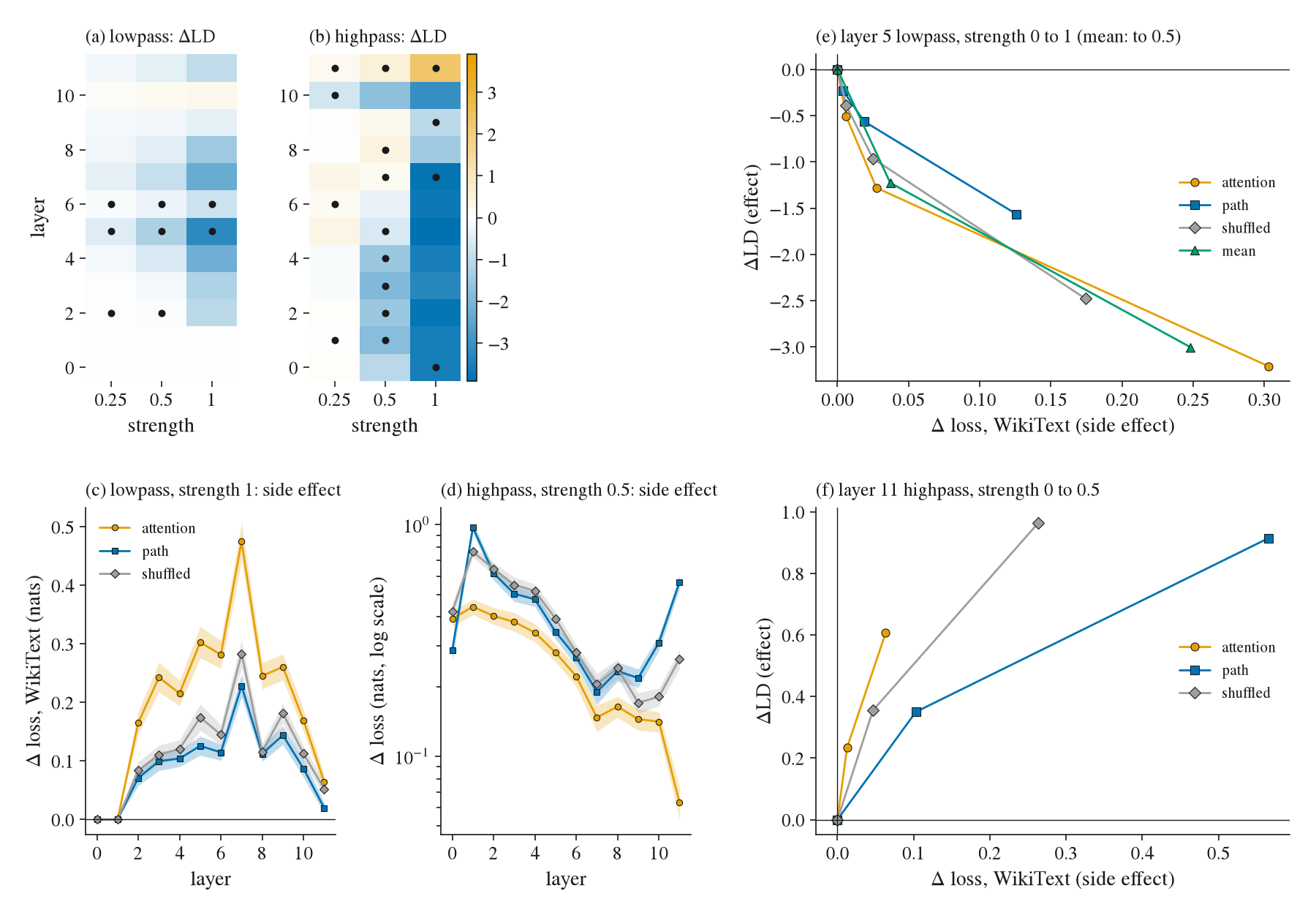
GPT-2 small, attention-graph filters after each block. (a), (b) Change in the IOI logit difference; dots: the attention graph differs from both norm-matched controls. (c), (d) Change in WikiText loss per layer, attention graph against controls of the same edit size (bands: 95% intervals). (e), (f) Effect against side effect as the strength grows.
The edits have large, layer-specific effects. A low-pass at strength 1 lowers LD by 3.21 [2.80, 3.62] after block 5 (most of the clean 3.64) and by 0.38 [0.14, 0.62] after block 9, and raises it by 0.27 [0.11, 0.43] after block 10. A high-pass at strength 0.25 raises LD by 0.40 [0.31, 0.49] after block 5. After blocks 0 and 1 every mode of the attention graph lies below the cutoff, so the low-pass changes nothing there; the high-pass at strength 1 removes most of the signal at every layer and costs 4 to 9 nats.
Most of the effect on LD comes from the size of the edit. Path and shuffled edits of the same size move LD in the same direction in most cells. The attention graph differs from both controls in 24 of the 66 cells where its edit is not the identity, 12 times above and 10 times below them: no consistent advantage on the effect alone.
The side effect depends on the attention graph. At strength 1, smoothing along the attention graph costs 1.4 to 2.5 times the loss of smoothing of the same size along positions or along the shuffled graph, at every layer from 2 to 10 (panel c): after block 5, +0.30 [0.28, 0.33] nats against +0.13 [0.11, 0.14] for the path graph and +0.17 [0.15, 0.20] for the shuffled graph. Removing the attention graph's low frequencies costs less than removing those of the controls: after block 11 at strength 0.5, +0.06 [0.05, 0.07] nats against +0.56 [0.53, 0.60] and +0.26 [0.24, 0.29] (panel d). Across the 66 cells the loss differs from both controls in 39: the attention edit costs more than both in 14 (12 of them low-pass) and less than both in 18 (all high-pass).
On the trade-off, the attention graph helps in one place. After block 5 the attention low-pass, the shuffled low-pass and the prefix mean lie on one curve of effect against side effect (panel e): the attention graph moves further along it, not to a better point. After block 11 the attention high-pass raises LD by 0.61 [0.52, 0.69] for 0.06 nats, while the shuffled graph needs 0.26 nats for 0.96 and 0.05 nats for 0.35, and the path graph 0.10 nats for 0.35 (panel f). That layer was picked after the run, among 24 layer and filter pairs.
The low-pass is not a mean ablation. At the same strength the prefix mean is a much larger edit (relative size 0.34 to 0.60 at strength 1, against 0.10 to 0.31 for the attention low-pass after blocks 2 to 11) and costs 2.5 to 4.3 nats at strength 1, against at most 0.48 for the attention low-pass.
Controls and limits
- Controls: the positional chain graph and a row-shuffled attention graph,
both matched to the edit's norm per prompt, and the prefix mean at the same
strength. Edit size and the Dirichlet energy on the attention graph are
recorded for every cell in
outputs/graph_filter_steering.json. - One model, one cutoff, one task for the effect and one corpus for the side effect. The layer-11 trade-off was found by looking, not by a registered test.
- The finding that holds across layers is about side effects, not steering: along the attention graph, smoothing costs more and sharpening costs less than an edit of the same size along positions.
Related work
Token-axis filters on frozen representations were used for probing by Tamkin, Jurafsky and Goodman (2020, Language Through a Prism, NeurIPS), on a fixed Fourier basis, and learned as spectral probes by Müller-Eberstein, van der Goot and Plank (2022, Spectral Probing, EMNLP); Verma and Pilanci (2024, Towards Signal Processing in Large Language Models) train time-frequency filters into the model. Here the filter is a causal intervention on a frozen model, in the basis of the model's own attention graph. Evaluating a steering edit by its effect against its side effects follows AxBench (Wu et al., 2025) and SteerScope (Yang et al., 2026).
Reproduce
examples/use_cases/graph_filter_steering.py (91 min on 2 CPU threads;
--plot redraws the figure from outputs/graph_filter_steering.npz).