Frequency-resolved patching
Activation patching asks where a computation happens: copy one activation from a clean run into a corrupted run and see how much of the clean behaviour comes back. Frequency-resolved patching asks a finer question about the same activation: which part of it along the token axis carries the effect.
The method
At the input of block l the residual stream is a matrix X with one row per token. The clean run's attention at that layer, averaged over heads and symmetrised, is a graph on the same tokens. Its Laplacian has an orthonormal eigenbasis U, ordered by eigenvalue: low modes vary little across strongly connected tokens, high modes separate a token from the tokens it is linked to. A band of modes U_b is a subspace of the token axis, and
X' = X_corrupt + U_b U_bᵀ (X_clean − X_corrupt)
takes that band's coefficients from the clean run and every other coefficient from the corrupt run. The full band is plain patching; the empty band leaves the corrupt run unchanged.
import torch
import spectral_trust as st

model = st.SpectralModel.from_pretrained("gpt2")
tok = model.tokenizer
clean = tok("When Mary and John went to the store, John gave a drink to",
            return_tensors="pt").input_ids
corrupt = tok("When Alice and Bob went to the store, Carl gave a drink to",
              return_tensors="pt").input_ids
io, s = tok(" Mary").input_ids[0], tok(" John").input_ids[0]

def logit_diff(logits):
    return logits[:, -1, io] - logits[:, -1, s]

p = st.Patcher(model, clean, corrupt, forward_kwargs={"logits_to_keep": 1})
T = clean.shape[1]
specs = [st.PatchSpec("resid_pre", layer, band=band, basis=basis)
         for layer in range(12)
         for basis in ("clean_attention", "path")
         for band in st.equal_count_bands(T, 4)]
ld = p.patch_many(specs, metric=logit_diff)              # [len(specs), 1]
Two controls belong with every band:
basis="path": the chain graph over positions, whose eigenvectors are cosines along the sequence. It has the same number of modes per band and knows nothing about the attention. If a positional band recovers as much as an attention band, the attention graph adds nothing.basis="random"with a seed: a Haar-random orthonormal basis, the null for a subspace of the same size. Any k-dimensional subspace of a T-dimensional token axis carries part of the difference by chance.
And one positional reference: plain patching at the END position only
(positions=[-1]), the cheapest explanation of any recovery at the last
token.
On IOI
A registered pilot ran this on GPT-2 small: the 200 IOI prompts of the official dataset code (Wang et al., 2022), their ABC counterparts (the IO name, both S names, then S1 alone replaced by random names), the input of every block, K = 8 equal-count bands of the clean attention basis, the path basis and the corrupt attention basis, 50 random bases per band size at the layer that qualified, and a decision rule fixed before any number was computed. Recovery is the fraction of the clean − corrupt logit difference that comes back, as a ratio of means over prompts: clean LD 3.64, corrupt LD 0.28.
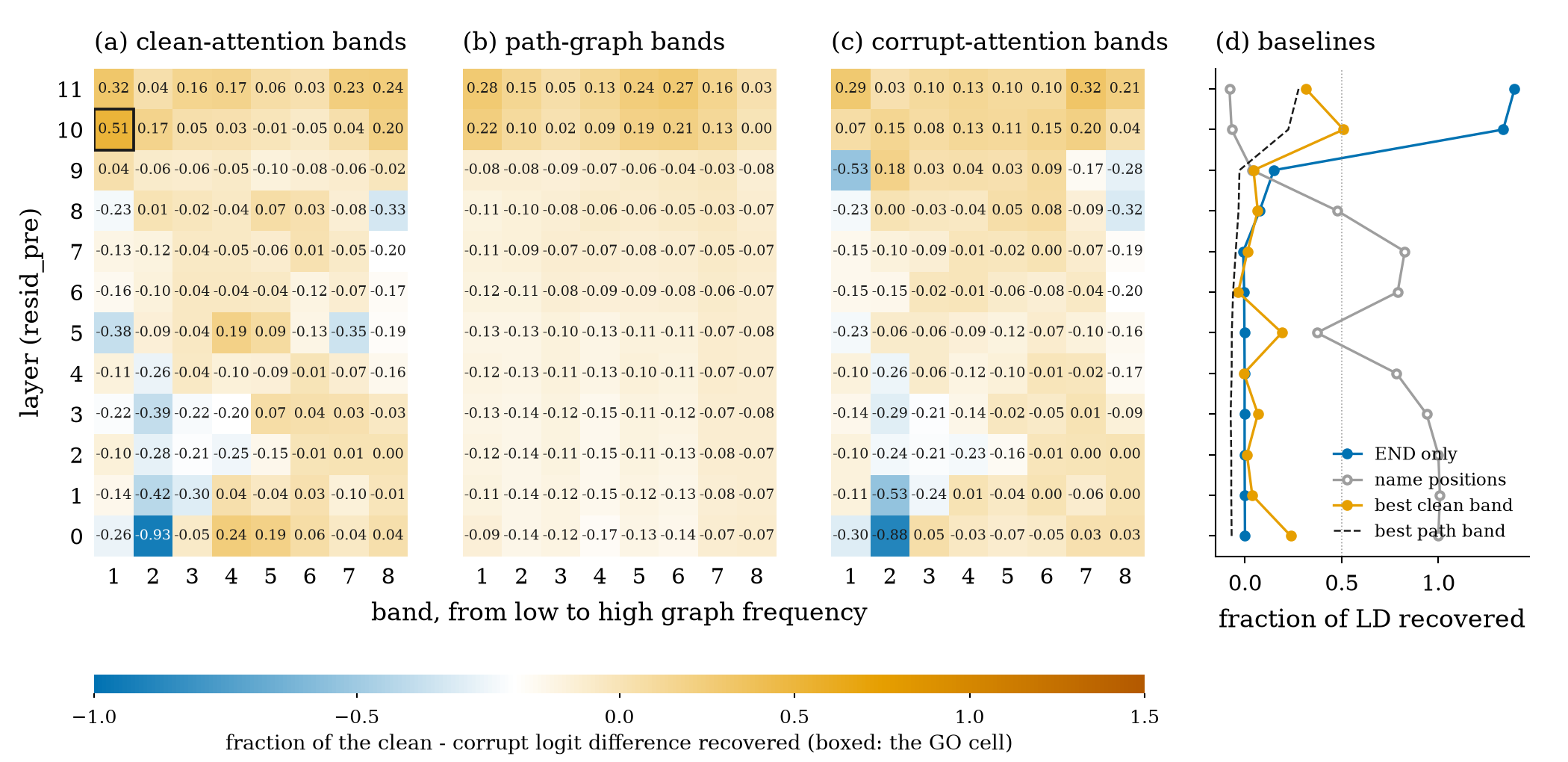
Fraction of the logit difference recovered by patching one band of the residual stream at the input of each block, GPT-2 small, 200 IOI prompts. (a)–(c): bands of three bases, low to high graph frequency. (d): plain patching at END only and at the three name positions, and the best band of (a) and (b) per layer.
One band passes, narrowly. At the input of block 10, the lowest band of the clean attention basis (at most 2 to 3 modes of a 14- to 20-token prompt) recovers 0.51 [0.46, 0.55] of the logit difference. A random subspace of the same size recovers at most 0.18 (95th percentile of 50 draws), the best path band at that layer 0.22, and the difference to the best path band is 0.29 [0.24, 0.32] (0.19 to 0.34 with a Bonferroni correction over the 96 cells). The same band of the corrupt run's attention basis recovers 0.07, so the band is a property of the clean run's graph. It is the only one of 96 cells with a recovery of 0.50 or more, and on the odd-indexed half of the prompts it falls below 0.50.
The END position is the stronger summary. Patching the residual stream at the END position alone recovers 1.34 at the same layer (1.39 at block 11), more than the full patch. The lowest band's projector puts 0.19 of its diagonal mass on END, against 0.125 for an even spread, so it overlaps the END position but carries less of what matters. Whoever wants the most compact description of where the answer sits at layer 10 should patch the position, not the band.
Below layer 10 the bands do not add up. At the inputs of blocks 0 to 9 the eight band recoveries of the clean attention basis sum to between −0.97 and −0.40, while patching all eight recovers 1. Single bands often push the logit difference the wrong way (−0.93 for the second band at block 0). In these layers the name positions alone recover most of the difference (1.00 at block 0, 0.78 at block 4), and every band mode has weight on many positions, so a band patch writes part of each name's clean value onto other tokens. Band recoveries are not an additive decomposition of the effect.
Controls and limits
- Controls: a positional basis (path graph) with bands of the same sizes, 50 Haar-random subspaces per band size at the qualifying layer, the corrupt run's attention basis, and plain patching at END and at the name positions. Intervals are 95% paired bootstrap intervals over prompts.
- One model, one task, one partition into 8 bands. The result is a recovery of the logit difference, not of the model's behaviour on other inputs.
- The positional baseline wins at the one layer where a band passes, so the pilot does not show that graph frequencies describe the IOI computation better than positions do. It shows that the method separates bands that matter from bands that do not, with controls that can say no.
Reproduce
examples/use_cases/frequency_patching.py recomputes the clean-attention
and path-graph maps and the END-only patch with st.Patcher (15 min on 2
CPU threads; --n-random 10 adds random bases). With the released library
it matches the registered pilot's maps to within 1e-6 (the pilot ran on a
pre-release commit); the full band gives a recovery of 1.000 at every layer.
The pilot's summary is in
examples/use_cases/outputs/frequency_patching_pilot.json, the
recomputation in examples/use_cases/outputs/frequency_patching.json.